
Digitakt II: Elektron's Sampling Powerhouse Gets a Stereo Sequel
Overview
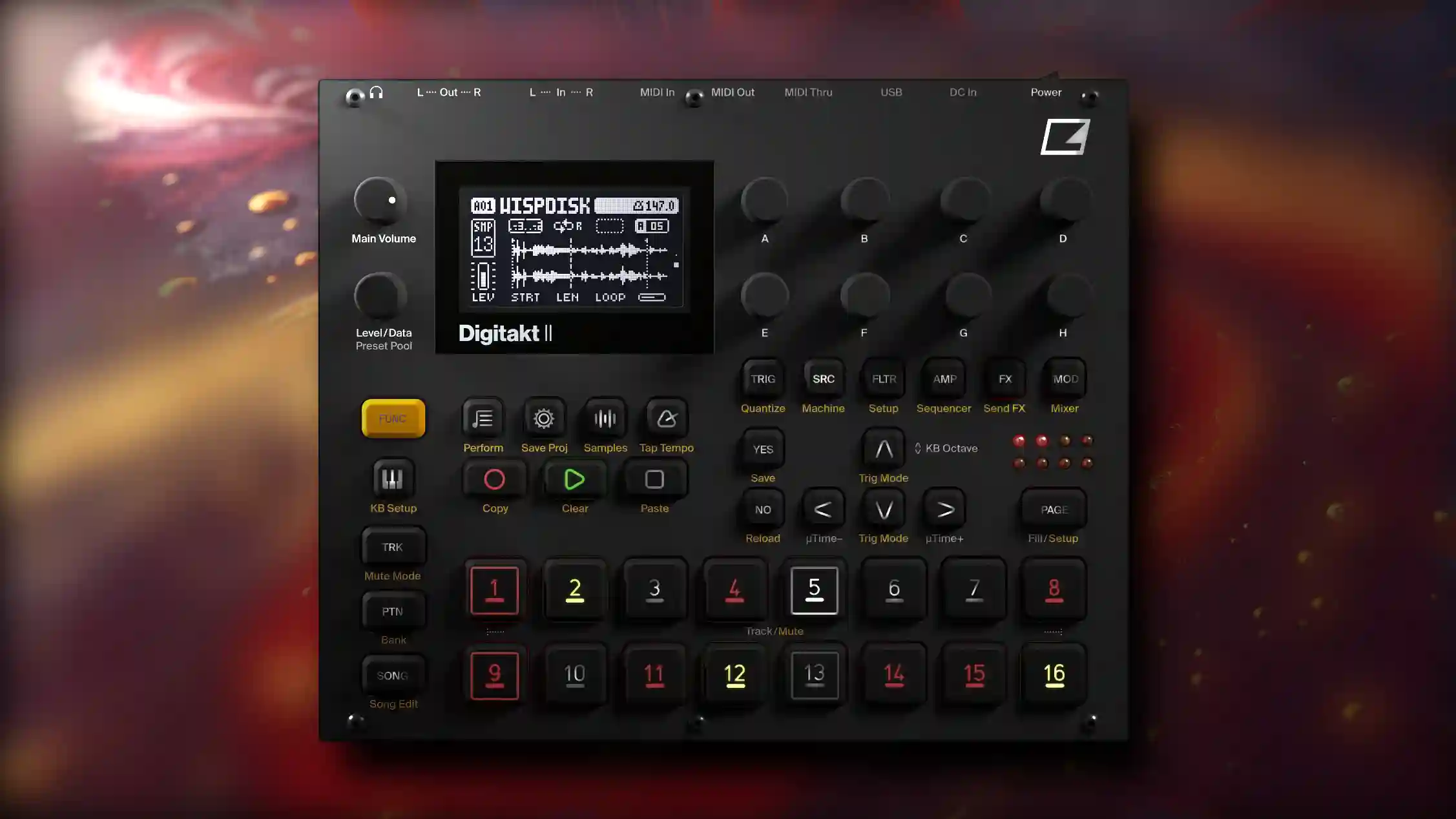
The Elektron Digitakt II is the eagerly awaited successor to the hugely popular sampler and drum machine that found its way into countless studios. At its core, the Digitakt II is an answer to the biggest requests from its dedicated user base. Elektron has fundamentally supercharged its beloved creation by doubling the track count, introducing true stereo sampling, and massively expanding the memory, addressing the primary limitations of the original unit (Truss). This isn't just a minor update; it's a complete internal overhaul designed to be a deeper, more powerful creative hub while maintaining the iconic workflow that made the first one famous. For those ready to make the leap, you can find the Elektron Digitakt II Sampler and Sequencer on zzounds.com.
Key Features
- Tracks: 16 audio tracks, which can be configured for stereo or mono samples, or as MIDI tracks.
- Sampling: Full stereo sampling and internal resampling.
- Sequencer: Famed 128-step Elektron sequencer with individual track lengths, time scales, and Parameter Locks.
- New Sequencer Features: Includes a Euclidean sequence generator for creating complex, evolving rhythms.
- Memory: 400 MB of sample memory and 20 GB of internal +Drive storage.
- Modulation: Three assignable LFOs per track, plus dedicated envelopes.
- Filters: One base-width filter plus a choice of a second filter from Multi-mode, Low pass 4, Comb, EQ, or Legacy LP/HP per track.
- Effects: Per-track effects include overdrive, bit reduction, and sample reduction, plus send effects like chorus, delay, and reverb.
- Workflow: Features Song Mode, Kits for sound management, and four distinct Trig Modes for performance.
Professional Reviews Summary
Professional critics agree that the Digitakt II is a monumental upgrade that successfully addresses the shortcomings of its predecessor. The move to stereo sampling, coupled with a massive increase in both RAM and internal storage, is universally praised as a game-changer (Truss). The expanded sonic toolkit, including versatile new filters and a third LFO for each track, significantly deepens its sound design capabilities, putting its modulation power ahead of even some of Elektron's higher-end devices (Sherbourne). The addition of the 128-step sequencer and the creative Euclidean generator is seen as a fantastic evolution of Elektron's already legendary sequencing power. However, the praise is not without critique. The workflow, while powerful, is still described as potentially "complex and unintuitive" for those not already indoctrinated into the Elektron ecosystem (Truss). Furthermore, while it's a powerful sampler, it still lacks some of the advanced performance features of its older sibling, the Octatrack, such as a "true slice mode" (Sherbourne).
User Sentiment Summary
User feedback has been largely positive, with many longtime fans celebrating the upgrades as exactly what they were hoping for. The community has expressed excitement over the creative freedom offered by stereo sampling and the vastly expanded memory, which reduces the need for constant sample management. Many users feel the new version is an incredibly "capable and inspiring" machine. However, the launch was met with some frustration. A significant point of contention was the absence of a manual sample slicing mode at release, a feature many consider fundamental to a hardware sampler. The initial lack of support for Elektron's popular Overbridge software for DAW integration was another common complaint, though users familiar with Elektron's strong track record of firmware updates remain hopeful.
Pros
- Massively expanded audio capabilities with 16 stereo tracks (Truss).
- Vastly increased memory (400MB RAM) and storage (20GB), a huge improvement over the original ("An all-round upgrade").
- Deeply powerful sequencer, now with 128 steps and a creative Euclidean mode (Truss).
- Enhanced sound design potential with new filters and three LFOs per track (Sherbourne).
- Maintains the beloved form factor and core workflow of the original.
Cons
- The deep Elektron workflow can be convoluted and challenging for newcomers (Truss).
- Lacks some performance features found on other Elektron machines, like the Octatrack's dedicated slicer or the Analog Rytm's "Direct Jump" mode (Sherbourne).
- Key features like manual sample slicing and Overbridge support were not available at launch, frustrating some early adopters.
Ideal For
The Elektron Digitakt II is ideal for intermediate to advanced electronic music producers, beatmakers, and sound designers who thrive on creative limitations and a unique workflow. It is a perfect centerpiece for a hardware-based studio, acting as both a powerful sampler and a MIDI brain for other gear. It is less suited for beginners or musicians looking for a simple, immediate plug-and-play drum machine.
Competing Products
Akai MPC One+
A major competitor that offers a more traditional, pad-based workflow centered around a touchscreen. The MPC is often seen as a more straightforward "DAW-in-a-box" experience, whereas the Digitakt II is geared more toward sonic experimentation and "happy accidents" through its sequencer.
Elektron Octatrack MKII
The Digitakt II's bigger, older sibling. The Octatrack is a more complex performance sampler with features like a crossfader, multiple inputs/outputs, and more advanced sample mangling capabilities, but it has a steeper learning curve and a more dated internal architecture compared to the modernized Digitakt II (Sherbourne).
Works Cited
- Sherbourne, Simon. "Elektron Digitakt II." Sound On Sound, Nov. 2024, www.soundonsound.com/reviews/elektron-digitakt-ii.
- Truss, Si. “Elektron Digitakt II Review.” MusicRadar, 16 Oct. 2024, www.musicradar.com/reviews/elektron-digitakt-ii.
- “Digitakt 2 - An Honest Review.” Reddit, 21 May 2024, www.reddit.com/r/Elektron/comments/1cx6j1c/digitakt_2_an_honest_review/.